Correct Pectus Excavatum Permanently with the Gold Standard Nuss Procedure

Restore your chest wall anatomy and improve cardiac function with the MIRPE Technique. Performed by Prof. Dr. Erkan Yıldırım using advanced epidural analgesia for pain management.


Pectus Excavatum (Funnel Chest) is the most common congenital chest wall deformity, occurring in approximately 1 in 300-400 births. It is not just a cosmetic issue; modern literature defines it as a mechanical pathology that can compress the heart and lungs. We offer a minimally invasive correction that prioritizes both your health and aesthetic appearance.


Correct Pectus Excavatum Permanently with the Gold Standard Nuss Procedure

Restore your chest wall anatomy and improve cardiac function with the MIRPE Technique. Performed by Prof. Dr. Erkan Yıldırım using advanced epidural analgesia for pain management.


Pectus Excavatum (Funnel Chest) is the most common congenital chest wall deformity, occurring in approximately 1 in 300-400 births. It is not just a cosmetic issue; modern literature defines it as a mechanical pathology that can compress the heart and lungs. We offer a minimally invasive correction that prioritizes both your health and aesthetic appearance.


Ready to Make Peace with the Mirror?

    We know it's hard to share photos. Your privacy is our priority. Your images are seen only by Prof. Dr. Erkan Yıldırım to guide you.

    More Than Appearance: Understanding the Health Risks

    While many patients seek treatment for the sunken appearance, Pectus Excavatum can lead to functional impairment. Severe cases, characterized by a Haller Index greater than 3.25 on a CT scan, often require surgical intervention.

    The Physiological Impact:
    • Cardiac Compression: The sunken sternum presses directly on the right ventricle of the heart, limiting its filling capacity.
    • Exercise Intolerance: Patients often experience palpitations and shortness of breath during physical activity due to restricted lung volume.
    • Proven Improvement: Clinical studies (Kelly et al.) confirm that surgical correction significantly improves cardiac output and stroke volume.

    The Nuss Procedure (MIRPE): A Revolutionary Approach

    We utilize the Minimally Invasive Repair of Pectus Excavatum (MIRPE), globally recognized as the gold standard. Unlike traditional open surgeries (Ravitch) that require cartilage resection, the Nuss procedure is a "closed" technique.

    How It Works:
    • No Bone Cutting: A customized metal bar is inserted through small incisions on the sides of the chest.
    • Instant Correction: The bar is placed retrosternally (behind the breastbone) to push the sternum outward, correcting the deformity instantly.
    • Remodeling: The bar acts like braces for the chest, staying in place for 2 to 3 years until the chest wall permanently hardens in the correct position.
    1

    Evaluation & Diagnosis

    We start with a physical exam and a thoracic CT scan. We calculate your Haller Index; if the ratio is greater than 3.25, surgical correction is planned to prevent cardiac compression.
    2

    The Nuss Procedure

    Through small lateral incisions, a curved steel or titanium bar is placed retrosternally (behind the breastbone). This instantly pushes the sternum out without any bone cutting or cartilage removal.
    3

    Epidural Analgesia

    We use advanced Cryoanalgesia (nerve freezing) to temporarily block pain nerves. This significantly reduces post-op pain, shortens hospital stay, and allows for a comfortable recovery.
    4

    Final Remodeling

    The bar acts like braces for the chest and stays in place for 2.5 to 3 years. Once the chest wall permanently hardens in the correct position, the bar is removed in a short outpatient procedure.

    Pain-Free Recovery with Cryoanalgesia

    Fear of post-operative pain is a thing of the past. Prof. Dr. Erkan Yıldırım employs Intercostal Nerve Cryoablation (Cryoanalgesia).

    What is it? We temporarily "freeze" the nerves responsible for pain in the chest area during surgery. * The Benefit: This dramatically minimizes pain, reduces the need for heavy painkillers, and allows for a much faster hospital discharge.
    1

    Blocked Pain

    Blocked Pain Signals By temporarily freezing the intercostal nerves during surgery, we stop pain transmission at the source ,. This provides a numbing effect that shields you from acute surgical pain.
    2

    Reduced Medication

    Reduced Medication Since the pain is blocked at the nerve level, the need for heavy opioid painkillers is drastically reduced. This prevents side effects like nausea and grogginess, keeping you alert.
    3

    Immediate Mobility

    Immediate Mobility Patients are not confined to bed. With pain under control, you can typically stand up, walk, and perform breathing exercises comfortably on the very first day after surgery.
    4

    Faster Discharge

    Faster Discharge With no need for continuous IV pain management, recovery is accelerated. Most international patients are discharged from the hospital to their hotel within just 2 to 3 days.

    The Nuss Procedure (MIRPE): A Revolutionary Approach

    We utilize the Minimally Invasive Repair of Pectus Excavatum (MIRPE), globally recognized as the gold standard. Unlike traditional open surgeries (Ravitch) that require cartilage resection, the Nuss procedure is a "closed" technique.

    How It Works:
    • No Bone Cutting: A customized metal bar is inserted through small incisions on the sides of the chest.
    • Instant Correction: The bar is placed retrosternally (behind the breastbone) to push the sternum outward, correcting the deformity instantly.
    • Remodeling: The bar acts like braces for the chest, staying in place for 2 to 3 years until the chest wall permanently hardens in the correct position.

    Pectus Carinatum (Pigeon Chest)

    Pectus Carinatum Treatment: Non-Surgical and Aesthetic Solutions Description: Pectus Carinatum, characterized by the outward protrusion of the breastbone, can impact both physical health and self-confidence. Led by Prof. Dr. Erkan Yıldırım, we offer personalized bracing (orthosis) systems and minimally invasive surgical options to restore a natural chest contour and boost patient well-being.

    • Non-Surgical Brace Therapy: For patients with flexible chest walls, we achieve excellent results using custom-fitted, dynamic compression bracing without the need for surgery.
    • Abramson Procedure (Minimal Invasive): In advanced cases, we utilize the closed surgical method through small incisions, ensuring rapid recovery and minimal scarring.
    • Psychological & Physical Relief: Correcting the deformity eliminates social anxiety and allows teenagers and young adults to participate in sports and social activities confidently.
    • Expert Diagnosis & Precision: We use advanced imaging to analyze the chest wall structure, creating a data-driven treatment plan tailored specifically to the patient’s development.

    Pectus Arcuatum (Currarino Type / Mixed Deformity)

    Pectus Arcuatum Correction: Specialist Care for Complex Deformities Description: Pectus Arcuatum is a rare and complex "mixed" deformity involving both protrusion and depression of the sternum. As one of the most challenging chest wall conditions, it requires the high-level surgical expertise of Prof. Dr. Erkan Yıldırım to achieve functional health and aesthetic symmetry.

    • Targeted Treatment for Mixed Forms: We specialize in addressing the unique "S-shape" curvature of the sternum that combines elements of both Pectus Excavatum and Carinatum.
    • Advanced Surgical Reconstruction: Utilizing specialized techniques (such as the modified Ravitch or custom osteotomy), we reshape the rigid cartilage to create a flat, stable, and natural chest profile.
    • Restoring Vital Functions: We focus on relieving any potential pressure on the heart and lungs, ensuring long-term cardiovascular efficiency and improved breathing capacity.
    • Global Expertise in Rare Cases: Benefit from Prof. Dr. Erkan Yıldırım’s international experience in managing rare pectus variations with a focus on patient safety and post-operative comfort.

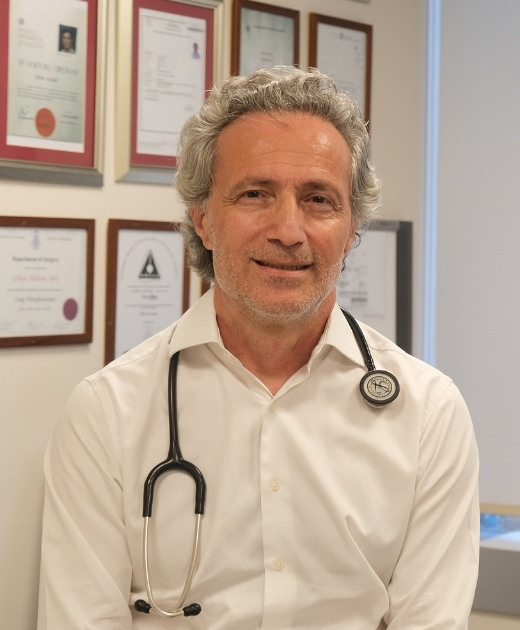
    Prof. Erkan Yıldırım, MD, PhD, FETCS

    Senior Thoracic & Lung Transplant Surgeon

    With over three decades of clinical excellence, Prof. Dr. Erkan Yıldırım is a European-board certified (FETCS) Thoracic Surgeon specializing in advanced minimally invasive techniques and complex pulmonary procedures. His career is marked by international training and a commitment to delivering life-changing surgical outcomes.

    Key Expertise & Specializations:

    Hyperhidrosis Specialist: A leading expert in the Closed Endoscopic Thoracic Sympathectomy (ETS) technique for the permanent treatment of excessive sweating (hands, armpits, face, feet sweating and facial blushing).

    Microsurgical intercostal nerve anastomosis for compensatory (reflex) sweating.
    Advanced MIS (Minimally Invasive Surgery): Expert in Uniportal VATS (Video-Assisted Thoracic Surgery) for lung cancer, oncological procedures, and emphysema.

    Pectus Deformity Correction: Specialized in minimally invasive repairs for Pectus Excavatum and Carinatum (Nuss & Abramson procedures).

    Lung Transplantation: Achieved a prestigious surgical fellowship at the Toronto Lung Transplant Program, one of the world’s leading centers, participating in over 89 transplant procedures.

    COPD Ballon intervention for COPD GOLD 3&4 Diseases

    Why Choose Prof. Dr. Erkan Yıldırım?

    International Excellence: European Board of Thoracic Surgery (EBTCS) certified and trained in world-class institutions in Canada and Switzerland.

    Innovation-Driven: A pioneer in Uniportal VATS and advanced thoracic oncological surgeries.

    Patient-Centered Care: Offering high-safety protocols and affordable, gold-standard treatment plans for international patients in Istanbul.

    • Mert A.
      Thoracic surgeon Dr. Erkan and his assistant were amazing. They explained the entire Nuss procedure to me and made me feel so comfortable. I was walking the very next day after surgery. A big thank you to everyone at the hospital!
      Mert A.
    • Can B.
      I had the Abramson surgery for my pigeon chest. The whole process, from the first consultation with Dr. Erkan to the care by the nurses, was perfect. My chest looks completely normal now, and my confidence is back.
      Can B.
    •  Giorgi M.
      I traveled to Istanbul for Pectus Excavatum surgery. The shortness of breath I had for years is completely gone. Dr. Erkan is a brilliant surgeon, and the hospital facilities were top-notch. Highly recommend!
      Giorgi M.
    • Ayşe K.
      My son started brace therapy for his pigeon chest under Dr. Erkan Yıldırım's supervision. In just a few months, the difference is unbelievable. The doctor and the hospital staff are always so helpful and kind
      Ayşe K.
    • Liam T.
      I had the Nuss procedure with Dr. Erkan for my sunken chest. I was so scared of the pain, but thanks to the nerve-freezing technique, I barely felt anything. Discharged in just 3 days! Huge thanks to the whole team.
      Liam T.

    Frequently Asked Questions

    1Is Pectus Excavatum purely cosmetic?
    No. Clinical studies show that severe depression causes cardiac displacement (compression of the heart) and reduces stroke volume during exercise.
    2What is the best age for surgery?
    The ideal age is between 12 and 16 years, when the chest wall is still flexible. However, modern techniques allow us to achieve successful outcomes in adult patients as well.
    3What is the "Haller Index"?
    It is a ratio calculated via CT scan to measure the severity of the depression. A score greater than 3.25 indicates that surgery is medically necessary.
    4Will the surgery be painful?
    We use Epidural analgesia during the operation. This significantly blocks pain signals, making the recovery process much more comfortable compared to traditional methods.
    5How long do the bars stay in the body?
    The bars are typically left in place for 2.5 to 3 years. This duration ensures that the chest wall permanently remodels into its new position.
    6Is surgery always necessary for Pectus Carinatum?
    No. For patients with flexible chest walls, especially during adolescence, orthosis (brace) therapy is often the first and most successful line of treatment. Surgery is typically reserved for adult patients or cases where the chest wall is too rigid for a brace.
    7How long does the bracing treatment take to show results?
    While every patient is different, visible improvement can often be seen within 6 to 12 months. However, consistent use (usually 14-20 hours a day) is critical for a permanent correction of the bone structure.
    8What is the Abramson Procedure, and is it similar to the Nuss Procedure?
    Yes, the Abramson Procedure is essentially the "Nuss for Carinatum." It is a minimally invasive technique where a metal bar is placed under the skin but over the sternum to push it back into place. It avoids large incisions and offers a much faster recovery compared to open surgery.
    1Can I have an allergic reaction to the metal bar?
    Nickel allergy is possible with stainless steel bars. If you have a known allergy, we use custom Titanium bars to prevent any reaction.
    2When can I resume sports?
    You can start light exercises (like walking) at 6 weeks. Full activity, excluding heavy contact sports, is usually permitted after 3-6 months.
    3Can specialized exercises fix the bone structure?
    Exercises can improve posture and muscle volume, which may mask the deformity, but they cannot anatomically correct the skeletal bone structure.
    4Why is Pectus Arcuatum harder to treat than other types?
    Because it involves both a protrusion and a depression (an "S" shape), standard braces or single bars often aren't enough. It requires a highly specialized surgical approach—often a Modified Ravitch or a custom combination of techniques—to reshape the rigid cartilage effectively.
    5At what age should Pectus Arcuatum be treated?
    Since Arcuatum involves a premature fusion of the sternum (making it very rigid), early diagnosis is vital. While it can be treated in adulthood, the best results are often achieved in late childhood or early puberty before the chest wall fully hardens.
    6Will the deformity return after surgery?
    When performed by an experienced thoracic surgeon like Prof. Dr. Erkan Yıldırım using modern stabilization techniques, the recurrence rate is extremely low. The goal is a permanent, lifetime correction of the chest wall's anatomy.